
Comfyui_TTP_Toolset
This is a workflow for my simple logic amazing upscale node for DIT model. it can be common use for Flux,Hunyuan,SD3 It can simple tile the initial image into pieces and then use image-interrogator to get each tile prompts for more accurate upscale process. The condition will be properly handled and the hallucination will be significantly eliminated.
Nodes (28)
Carry a previous clip's tail into a new generation
Pin the start and end of an LTX video
Anchor an LTX video anywhere, not just the ends
Same sampler, real speedup, know the trade
Stamp per-tile prompts to their regions and merge
The experimental cousin, with tile grouping
Stack per-tile conditionings into one batch
Turn tile positions into conditioning coordinates
Pad a canvas and get the outpaint mask for free
Stitch a tile batch back into one seamless image
Cut a big image into a tile batch for upscaling
The ControlNet Tile conditioning image, minus the fuss
Load the vision model Smart Tile's Auto Tile needs
The last node in the Smart Tile loop, and the one with the most dials
Manually override how specific tiles get pasted back
Enlarge each loop tile before it hits the sampler
The entry point of Smart Tile 2.0
Catching each tile on its way back
The node that hands your sampler one tile at a time
Figuring out how big your canvas actually got
Rewriting just the tiles you actually care about
Let a vision model caption your tiles for you
Don't let a loop flood your output folder
Telling Assemble which tiles actually matter
Check your tile layout before you burn GPU time
The manual override when auto-ranking isn't enough
Combine three text snippets through a template
Pick tile dimensions by grid factor, not raw pixels
ComfyUI TTP Toolset
ComfyUI TTP Toolset is a collection of tiled upscale, Smart Tile, video sampler, coordinate, and conditioning helper nodes. The current main feature is Smart Tile 2.0, an object-aware tiled img2img workflow with automatic layout, per-tile prompts, loop processing, semantic priority, mask-aware assembly, and final-only saving.
ComfyUI TTP Toolset 是一组围绕分块放大、Smart Tile、视频采样、坐标处理和条件处理的 ComfyUI 节点集合。当前主推功能是 Smart Tile 2.0:它支持语义自动分块、逐 tile 提示词、循环采样、语义层级、蒙版拼合和只保存最终结果。
Feature Blocks / 功能模块
| Feature block / 功能块 | Status / 状态 | What it is for / 用途 | |---|---|---| | Smart Tile 2.0 | Current main feature / 当前主推 | Object-aware variable-size tile workflow for detail img2img upscale. / 面向细节重绘放大的语义可变尺寸分块流程。 | | TTP Tile 1.0 | Legacy workflow / 旧版流程 | Fixed-grid image tiling and assembly for classic upscale workflows. / 传统固定网格切图、批处理和拼回流程。 | | Coordinate and conditioning utilities | Helper nodes / 辅助节点 | Coordinate splitting, condition batching, and condition merging. / 坐标拆分、条件批处理和条件合并。 | | LTX workflow examples | Example workflows / 示例工作流 | First/last frame and middle-frame control examples. / 首尾帧与中间帧控制示例。 | | TeaCache for Hunyuan Video | Extra tool / 额外工具 | Faster Hunyuan Video sampling with TeaCache. / 使用 TeaCache 加速 Hunyuan Video 采样。 |
Smart Tile 2.0: Object-Aware Tile Loop / 语义分块循环
Smart Tile is an object-aware tiled img2img workflow for ComfyUI. Instead of cutting every image into equal squares, it lets you build variable-size tiles around visual structure: face, eyes, hands, text, subject, clothing, foreground details, and background/context regions.
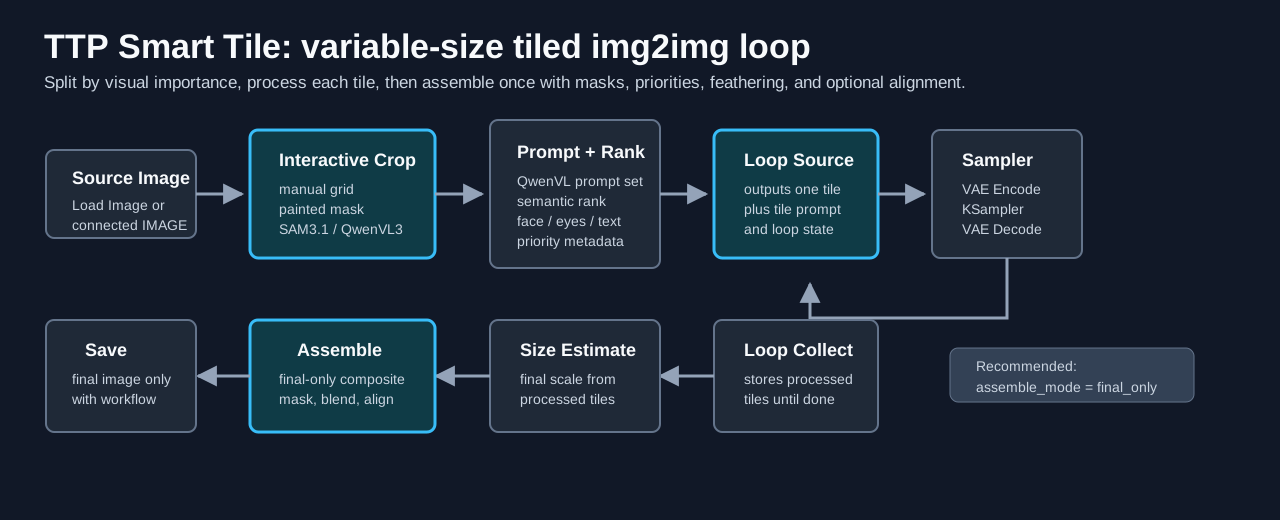
Smart Tile is designed for workflows where small areas need more detail than the full image. You can draw or auto-detect tiles, process one tile at a time through your sampler, then assemble the final image with feathering, masks, semantic priority, color correction, and optional pixel alignment.
What It Solves
- Avoids cutting important objects through the middle when a simple grid would split a face, hand, or text.
- Allows different tile sizes, so a face tile can be small and high detail while the background stays large.
- Sends one tile at a time through img2img, so the number of tiles can be 4, 8, 16, or anything produced by the editor.
- Keeps high-detail focus tiles visible during assembly with priority, layer, and semantic ranking.
- Supports mask-aware pasteback, soft detail overlay, final-only assembly, and black-base canvas mode.
Visual Tile Editor
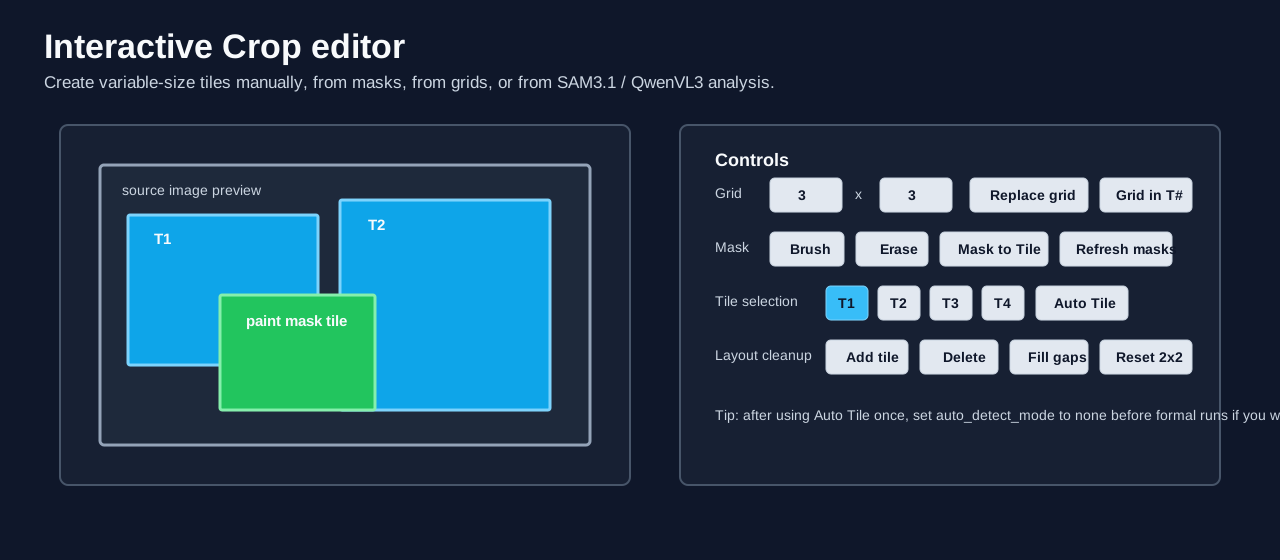
TTP Smart Tile Interactive Crop is the recommended starting point. It can load an image like ComfyUI's official Load Image, or receive a connected source_image. The editor stores the current layout in a hidden layout_json widget, so your workflow keeps the tile plan.
Useful editor actions:
Replace grid: replace the whole layout with an even grid.Grid in T#: subdivide the selected tile without rebuilding the whole layout.Show masks/Hide masks: toggle a colored overlay for tile object masks in the editor.Stitch mask/Raw masks: preview the hardened and feathered replace-paste mask shape without changing saved masks.Mask to Tile: turn painted regions into object tiles.Merge masks: Shift/Cmd/Ctrl-select multiple tiles, then union their cropped object masks back onto the selected tiles.Merge tiles: Shift/Cmd/Ctrl-select multiple tiles, then replace them with one larger tile; existing masks are unioned into the merged tile when available.Refresh masks: after manually moving sub-tiles from a masked tile, re-crop the inherited masks to the current tile boxes.Fill gaps: add background tiles for uncovered areas.Auto Tile: run SAM3.1 or QwenVL3 detection and write the detected layout back into the editor.Auto SAM: run SAM3.1 detection and keep only detected object tiles without automatic gap filling.
When subdividing a masked tile with Grid in, the Mask mode can crop the original object mask into child tiles or skip empty mask children. The child tiles keep a parent mask source, so Refresh masks can update them after manual edits.
Core Nodes
| Node | Purpose |
|---|---|
| TTP Smart Tile Interactive Crop | Load/connect an image, create manual/painted/auto tiles, and output a variable-size tile_set. |
| TTP Smart Tile Set Preview | Preview a tile set as a contact sheet or one selected tile. |
| TTP QwenVL3 Local Loader | Load a local QwenVL tagging model from ComfyUI/models/text_encoders. |
| TTP Smart Tile QwenVL Prompt Set Builder | Generate per-tile prompts before loop processing. |
| TTP Smart Tile Prompt Override | Filter selected tiles and replace, prepend, append, or find/replace per-tile prompts before sampling. |
| TTP Smart Tile Composite Override | Filter selected tiles and set composite mode, replace shape, layer, priority, occlusion priority, blend, and importance before assembly. |
| TTP Smart Tile Stack Order | Put tiles such as T1,T3,T2 at the front in that order, leaving all unlisted tiles behind. |
| TTP Smart Tile Semantic Rank | Classify tiles and write recommended layer, priority, scale weight, and composite metadata. |
| TTP Smart Tile Loop Source | Output one tile at a time for VAE Encode / sampler / VAE Decode. |
| TTP Smart Tile Loop Collect | Collect each processed tile back into the same tile set. |
| TTP Smart Tile Image Upscale Prep | Optionally upscale or resize each tile before sampling, with a megapixel cap. |
| TTP Smart Tile Output Size Estimate | Estimate final output scale/resolution from processed tile sizes. |
| TTP Smart Tile Assemble | Paste processed tiles back with feathering, masks, color correction, priority, optional GPU paste, and optional alignment. |
| TTP Smart Tile Save Final Image | Save only the final completed loop result and embed workflow metadata. |
Recommended Loop Workflow
TTP Smart Tile Interactive Crop
  -> TTP Smart Tile QwenVL Prompt Set Builder (optional)
  -> TTP Smart Tile Prompt Override (optional)
  -> TTP Smart Tile Composite Override (optional)
  -> TTP Smart Tile Semantic Rank (optional)
  -> TTP Smart Tile Loop Source
  -> VAE Encode / Sampler / VAE Decode
  -> TTP Smart Tile Loop Collect
  -> TTP Smart Tile Semantic Rank (optional final refresh)
  -> TTP Smart Tile Stack Order (optional final manual order)
  -> TTP Smart Tile Output Size Estimate (optional)
  -> TTP Smart Tile Assemble
  -> TTP Smart Tile Save Final Image
Use TTP Smart Tile Loop Source and TTP Smart Tile Loop Collect instead of manually duplicating sampler chains. The loop source outputs the current tile image and the current tile prompt. After the sampler finishes, loop collect stores the result and advances to the next tile.
By default, TTP Smart Tile Assemble uses assemble_mode=final_only. Connect TTP Smart Tile Loop Collect.done to TTP Smart Tile Assemble.done so unfinished loop runs return a lightweight preview while done=false, then perform the full assemble once after the last tile. Switch assemble_mode to always only when you really want a full recomposite after every tile. If pixel alignment is enabled, unfinished loop runs are automatically treated as final-only to avoid repeated expensive alignment passes.
Complete Example Workflow / 完整范例工作流
Example workflows / 示例工作流:
- Full Smart Tile loop / 完整 Smart Tile 循环:
examples/smart_tile_qwen_sam_loop_example_v2.json - Krea2 edit sampler workflow / Krea2 edit 采样工作流:
examples/ttp_smart_tile_example_Krea2_edit.json
这份工作流展示了当前推荐的 Smart Tile 完整链路:先用 TTP Smart Tile Interactive Crop 和 sam3.1 做 Auto Tile 分块,再用 TTP Smart Tile QwenVL Prompt Set Builder 生成每块提示词。随后 Semantic Rank 写入语义优先级,Loop Source 把 tile 一张一张送入 img2img,Image Upscale Prep 负责采样前放大,Loop Collect 收集结果,最后由 Output Size Estimate 估算画布尺寸,Assemble 在 final_only 模式下一次拼合,Save Final Image 只保存最终图。
This workflow is the recommended full Smart Tile loop. It uses TTP Smart Tile Interactive Crop with sam3.1 Auto Tile, prepares per-tile prompts with TTP Smart Tile QwenVL Prompt Set Builder, ranks tiles with Semantic Rank, sends one tile at a time through img2img with Loop Source, upscales each tile before sampling with Image Upscale Prep, collects results with Loop Collect, estimates the final canvas with Output Size Estimate, assembles once in final_only mode, and saves only the completed result.
Workflow overview / 工作流全景
<img src="docs/images/smart_tile_workflow_chrome_overview.png" alt="Smart Tile complete workflow in ComfyUI" width="960">Key views / 关键视图
<table> <tr> <td width="50%"><strong>Interactive editor / 交互分块编辑器</strong><br><img src="docs/images/smart_tile_chrome_interactive_editor.png" alt="Smart Tile interactive editor" width="420"></td> <td width="50%"><strong>Tile set preview / 分块预览</strong><br><img src="docs/images/smart_tile_chrome_tile_set_preview.png" alt="Smart Tile tile set preview" width="420"></td> </tr> <tr> <td width="50%"><strong>Weight preview / 权重预览</strong><br><img src="docs/images/smart_tile_chrome_weight_preview.png" alt="Smart Tile weight preview" width="420"></td> <td width="50%"><strong>Final preview / 最终预览</strong><br><img src="docs/images/smart_tile_chrome_final_preview.png" alt="Smart Tile final preview" width="420"></td> </tr> </table>Key settings / 关键设置
| Node / 节点 | Example setting / 示例设置 | Notes / 说明 |
|---|---|---|
| Interactive Crop | auto_detect_mode=sam3.1, default_pad=32, default_blend=32, auto_object_padding=64, auto_mask_expand=16, auto_max_tiles=16 | Use Auto Tile to create an object-aware layout, then set auto_detect_mode=none if you want to freeze manual edits. auto_mask_expand dilates object masks for edit pasteback; set it to 0 for exact masks. / 用 Auto Tile 生成语义分块;如果之后要固定手动编辑结果,可以把 auto_detect_mode 改回 none。auto_mask_expand 会膨胀对象蒙版,适合 edit 贴回;设为 0 则保留精确蒙版。 |
| QwenVL3 Local Loader | qwen3vl_4b_fp8_scaled.safetensors | Replace this with the QwenVL model installed in ComfyUI/models/text_encoders. / 按你本机 models/text_encoders 里的 QwenVL 模型替换。 |
| QwenVL Prompt Set Builder | reference_image_mode=first_message, prompt_preset=tile_img2img_prompt, output_language=chinese | Builds prompts before the tile loop, then Loop Source.prompt feeds the text encoder. / 在循环前一次性生成每块提示词,然后由 Loop Source.prompt 送入文本编码。 |
| Prompt Override | selector_type=label, selector=face, prompt_mode=replace | Rewrites only matched tile prompts. Use drop_unmatched when only selected regions should run through an edit sampler and Assemble should keep the rest from source_image. / 只改写匹配 tile 的提示词;局部 edit 时可用 drop_unmatched,其余区域由 Assemble 的 source_image 底图保留。 |
| Composite Override | selector_type=index, selector=T3, composite_mode=replace_tile, replace_tile_shape=mask_first, occlusion_priority_mode=max | Puts selected tiles above lower layers and makes them hard-replace the canvas. mask_first uses an object mask when present and hardens the mask interior like an inpaint stitch; tile_box_first ignores the mask and replaces the full tile box. / 把指定 tile 放到更高层并硬替换画布;mask_first 有 mask 就按 mask 替换,并像 inpaint stitch 一样硬化 mask 主体;tile_box_first 即使有 mask 也按完整 tile 方块替换。 |
| Stack Order | tile_order=T1,T3,T2, top_order=first_on_top, composite_mode=replace_tile | Makes the listed tiles the front stack in the typed order while all unlisted tiles stay behind. Place it after the final Semantic Rank so manual order wins. The tiles keep their own blend and mask feathering. / 按填写顺序把这些 tile 放到最前面,未填写的 tile 都在后面;建议放在最终 Semantic Rank 后面,让手动顺序最后生效;tile 仍使用各自的 blend 和 mask 羽化。 |
| Image Upscale Prep | scale=2.5, round_to=8, max_megapixels=1.5, use_upscale_model=true | Enlarges each tile before img2img while keeping each tile under the megapixel cap. / 采样前放大每块 tile,同时用百万像素上限控制显存。 |
| Loop Source / Loop Collect | Process All Tiles workflow | The tile count can be 4, 8, 16, or any layout count; no manual sampler duplication is needed. / 分块数量可以变化,不需要手动复制多套 sampler。 |
| Output Size Estimate | focus_weighted | Estimates the final canvas from processed tile sizes, giving more influence to focus/detail tiles. / 根据处理后的 tile 尺寸估算最终画布,并更重视细节块。 |
| Assemble | assemble_mode=final_only, mask_blend_mode=mask_feather, color_correction=histogram, small_tile_on_top=true, auto_composite_policy=safe_auto | Assembles only after the loop is done, uses mask-aware feathering, and keeps small detail tiles above larger context tiles. / 循环结束后只拼合一次,使用蒙版羽化,并让小细节块优先于大背景块。 |
Before running the example, replace model filenames such as the diffusion model, CLIP/text encoder, VAE, LoRA, and upscale model with files installed on your machine. The workflow is meant as a wiring reference; model choices can be changed freely.
运行示例前,请把 diffusion model、CLIP/text encoder、VAE、LoRA、upscale model 等模型名替换成你本机已经安装的文件。这份工作流主要作为连线参考,具体模型可以自由替换。
Auto Tile: SAM3.1 or QwenVL3
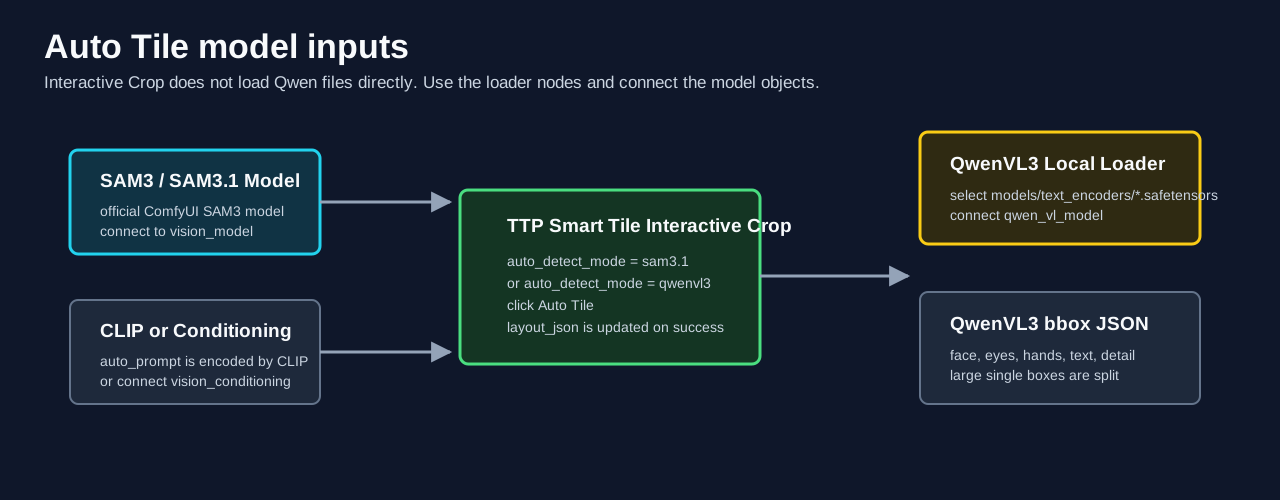
auto_detect_mode controls how Auto Tile analyzes the image:
| Mode | Required input | Notes |
|---|---|---|
| none | none | Auto Tile is disabled; use manual grid, painted masks, or saved layout. |
| sam3.1 | official SAM3/SAM3.1 model to vision_model, plus CLIP or vision_conditioning | Uses ComfyUI's official SAM3 Detect path. The built-in auto_prompt is encoded internally when clip is connected. |
| qwenvl3 | TTP QwenVL3 Local Loader -> qwen_vl_model | Uses QwenVL for bbox JSON. Model files are selected from ComfyUI/models/text_encoders. If Qwen returns one large full-frame box, Smart Tile splits it into useful detail tiles. |
For QwenVL3, TTP Smart Tile Interactive Crop does not read .safetensors directly. Add TTP QwenVL3 Local Loader, choose the QwenVL model file, then connect its qwen_vl_model output into Interactive Crop.
auto_max_tiles limits the total Auto Tile layout after automatic gap filling, so detected objects and generated background gap tiles stay within the same cap.
Per-Tile Prompts
For manual prompt workflows, connect TTP Smart Tile Loop Source.prompt to your text encoder path. For automatic prompt workflows, place TTP Smart Tile QwenVL Prompt Set Builder before the loop:
Interactive Crop
  -> QwenVL Prompt Set Builder
  -> Semantic Rank
  -> Loop Source
The prompt builder can use a full image, every tile, or a contact sheet as QwenVL visual context. It caches results by model file, tile hash, prompts, and seed, so reruns do not need to interrogate unchanged tiles again.
Upscale Prep and Size Estimate
TTP Smart Tile Image Upscale Prep prepares each loop tile before img2img sampling. It can use a connected ComfyUI UPSCALE_MODEL through the same tiled upscale-model path as the built-in upscale node, or fall back to lanczos, bicubic, bilinear, area, or nearest resize when no model is connected or use_upscale_model is off. scale sets the requested enlargement, max_megapixels caps the final tile pixel count, and round_to snaps the final width/height after the cap. When the cap is active, the node rounds down so the rounded tile stays under the megapixel budget. Tile coordinates are not changed; they remain in original-image space so assemble can map the processed tile back by sample_box and output_scale.
TTP Smart Tile Output Size Estimate reads the processed tile_set after Loop Collect and reports output_scale, final width/height, separate scale_x/scale_y, and a per-tile info log. The default median strategy matches Assemble's automatic tile-scale inference, and the output_scale output can be connected directly to TTP Smart Tile Assemble.output_scale. focus_weighted uses semantic scale weights so low-detail full/background tiles do not drag the final-only canvas scale below high-detail face/eye/text tiles. For final-only loops, connect TTP Smart Tile Loop Collect.done to both this node's done input and TTP Smart Tile Assemble.done; while done=false, this node returns a deferred zero-scale placeholder and skips tile scanning, then estimates once when done=true. Mixed tile scales are reported in the info string so capped or unevenly enlarged tiles are visible before final assembly.
Assembly, Masks, and Layer Priority
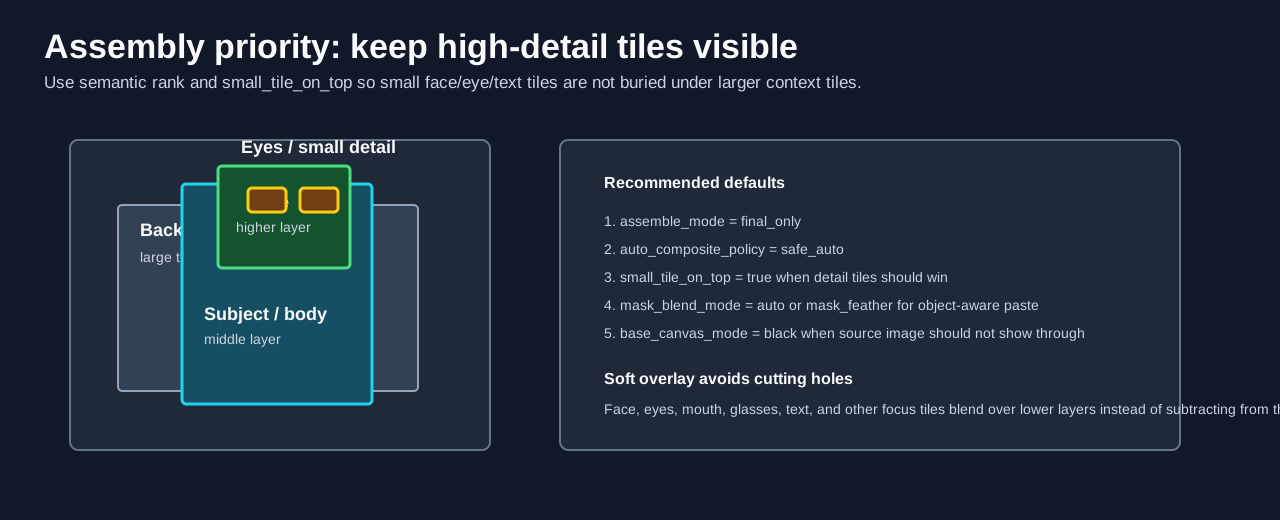
TTP Smart Tile Semantic Rank is optional, but useful after QwenVL prompting or auto/manual tile creation. It classifies each tile as background, subject, face, eyes, hands, text, detail, or normal from existing labels/captions/prompts, then writes semantic score, scale weight, recommended layer, priority, occlusion priority, and composite mode metadata back into the tile set. With apply_composite_rank on, face/eyes/text/detail tiles are promoted above background/context tiles and are marked for soft overlay blending.
Assembly options worth starting with:
| Setting | Suggested value | Why |
|---|---|---|
| assemble_mode | final_only | Assemble once when the loop is complete; much faster than recompositing every step. |
| assemble_device | auto or gpu | Uses GPU paste/weight accumulation when available. |
| base_canvas_mode | black when you do not want source pixels underneath | Prevents the original image from showing through uncovered or low-weight areas. |
| auto_composite_policy | safe_auto | Keeps background/context low and promotes focus/detail tiles. |
| auto_composite_policy | replace_tile | For edit workflows, hard-replaces selected tile regions over the base canvas. Combine with replace_tile_shape=mask_first for mask priority, or tile_box_first for full tile-box replacement. |
| replace_tile_shape | mask_first or tile_box_first | Controls replace-tile shape priority. mask_first uses object masks when available and hardens soft mask interiors so only the edge blends; tile_box_first ignores masks and pastes the full tile box. |
| small_tile_on_top | true for detail workflows | Helps small face/eye/text tiles win overlaps against larger body/context tiles. |
| mask_blend_mode | auto or mask_feather | Uses object masks when present and feathered rectangular masks otherwise. |
| color_correction | off first, then reinhard_lab, mkl_lab, or histogram as needed | Uses ComfyUI's official Transfer Color logic; reference defaults to the source image. |
Detail tiles should blend over lower layers instead of cutting holes into them. The safe auto policy treats face, eyes, mouth, glasses, text, and similar focus regions as soft overlays when possible.
Recommended Starting Parameters
| Scenario | Recommended settings |
|---|---|
| General manual grid | grid=3x3, default_pad=32, default_blend=32 or 64, round_to=8, include_full_image=false |
| Portrait/detail workflow | Auto Tile + Qwen/SAM prompt for person, face, eyes, hands, text, foreground object |
| Variable-size detail tiles | Use TTP Smart Tile Image Upscale Prep before sampler, then Output Size Estimate before Assemble |
| Avoid original image leaking through | base_canvas_mode=black |
| Small details should stay visible | small_tile_on_top=true, auto_composite_policy=safe_auto |
| Expensive alignment workflow | assemble_mode=final_only, connect done from Loop Collect |
| Strict manual layout | Keep Auto Tile mode as none after you finish editing, so formal runs do not replace your layout |
Troubleshooting
| Symptom | What to check |
|---|---|
| Auto Tile did not change the layout | Make sure auto_detect_mode is sam3.1 or qwenvl3, the required model input is connected, then read the editor status message. |
| QwenVL3 does not split the image | Confirm TTP QwenVL3 Local Loader is connected to qwen_vl_model. Qwen must return bbox JSON; Smart Tile accepts common bbox, bbox_2d, box_2d, objects, and xywh formats. |
| Running the full workflow replaces manual edits | Set auto_detect_mode=none after Auto Tile if you only wanted detection once, then manually edit the saved layout. |
| A manually moved mask tile still uses the old mask | Click Refresh masks after moving Grid-in child tiles from a masked parent. |
| Native Save Image saves multiple loop frames | Use TTP Smart Tile Save Final Image; loop previews are not treated as final output. |
| Face or eyes are hidden under a larger tile | Use TTP Smart Tile Semantic Rank, enable small_tile_on_top, and keep auto_composite_policy=safe_auto. |
| The original image shows through | Use base_canvas_mode=black and make sure Fill gaps has covered empty regions. |
| Assemble is slow | Use assemble_mode=final_only; avoid repeated pixel alignment during unfinished loop steps. |
Advanced Layout JSON
Example layout:
{
  "defaults": {
    "pad": 128,
    "blend": 48,
    "priority": 50,
    "importance": 1.0
  },
  "tiles": [
    {
      "name": "full_image",
      "x": 0,
      "y": 0,
      "w": 1.0,
      "h": 1.0,
      "pad": 0,
      "blend": 96,
      "priority": 10,
      "importance": 0.5
    },
    {
      "name": "face",
      "x": 0.35,
      "y": 0.08,
      "w": 0.30,
      "h": 0.28,
      "pad": 192,
      "blend": 64,
      "priority": 100,
      "importance": 1.0
    }
  ]
}
Coordinates can be pixel values or normalized values from 0.0 to 1.0. A rectangle whose coordinates are all in 0..1 is treated as normalized, including browser-serialized 0 and 1 edges. pad is seam overlap: it expands only the tile edges that touch another tile. Outer canvas edges and non-adjacent gap edges are not expanded. blend, priority, and importance control how the sampled tile is pasted back.
For standard grid layouts, edge tiles are expanded inward with real source pixels when needed so the ComfyUI IMAGE batch has a consistent size without fake outer padding. Irregular manual layouts with uncovered gaps may still need transport padding because a single IMAGE batch cannot contain mixed image sizes.
TTP Tile 1.0: Fixed-Grid Upscale Workflow / 旧版固定网格放大流程
TTP Tile 1.0 is the original fixed-grid upscale workflow. It cuts an image into equal-size tiles, processes them as a batch, then assembles them back into the original layout. This path is still useful for classic Flux, Hunyuan, SD3, and ControlNet Tile upscale workflows where a regular grid is enough.
TTP Tile 1.0 是这个项目最早的固定网格分块放大流程。它把图片切成等尺寸 tile,批量处理后再按原始位置拼回去。对于传统 Flux、Hunyuan、SD3、ControlNet Tile 等固定网格放大场景,它依然很实用。
1. Image Tile Batch Node
This node cuts an image into pieces automatically based on your specified width and height. It also records the necessary information for further processing.
| Parameter | Description | |-----------|-------------------------------------| | Width | The width of each tile. | | Height | The height of each tile. | | Image | The image to be tiled. |
Node View:
2. Image Assembly Node
This node reassembles image tiles back into a complete image while preventing visible lines between the tiles. It operates in pixel mode.
| Parameter | Description | |-------------|---------------------------------------------------------------| | Tiles | Input the tiled image batch. Replace individual tiles if needed. | | Position | Paired with the Image Tile Batch Node. | | Original Size | Paired with the Image Tile Batch Node. | | Grid Size | Paired with the Image Tile Batch Node. | | Padding | The padding value used to merge the image pieces. |
Node View:
3. Tile Image Size Node
This node calculates the resolution of each tile based on the original image dimensions and your specified width/height factors.
| Parameter | Description | |-------------------|--------------------------------------------------------------------| | Width Factor | Divides the image width into equal parts. | | Height Factor | Divides the image height into equal parts. |
For example: A width factor of 2 and a height factor of 3 will divide the image into 6 equal tiles.
Node View:
TTP Tile 1.0 Examples / 旧版示例
Pixel Example (Recommended)

Latent Example

ControlNet Tile Integration
This workflow supports ControlNet Tile for enhanced upscaling. Here's an example of using tiles with the Hunyuan DIT model:
| Resource | Link | |----------|-----------------------------------------------------------------------------------------------| | Tile Example | Hugging Face Tile | | Hunyuan 1.2 | Download Hunyuan 1.2 |
Workflow Example:

Other Tools / 其他功能
This section collects smaller tools and workflow helpers that are not part of the new Smart Tile 2.0 loop or the legacy TTP Tile 1.0 fixed-grid pipeline.
这一部分收纳不属于 Smart Tile 2.0 主流程、也不属于 TTP Tile 1.0 固定网格主流程的零散工具和辅助工作流。
LTX Frame Control Workflows / LTX 首尾帧与中间帧控制
The examples/ folder also includes LTX workflow examples for first/last frame and middle-frame control. These are separate workflow helpers and are not required for Smart Tile.
examples/ 目录里还包含 LTX 首尾帧、中间帧控制相关工作流示例。这些属于独立工作流辅助功能,不是 Smart Tile 的必需部分。
Coordinate and Conditioning Utilities / 坐标与条件辅助节点
Coordinate Splitter Node
This node converts position information into coordinates and connects them to the corresponding positions.
Node View:
Cond to Batch Node
This node converts condition lists into batches. It is reserved for future functionality expansion and connects to the conditions.
Node View:
Condition Merge Node
This node merges all tiled conditions into one and prepares them for building the final image. It connects to the Coordinate Splitter Node and Cond to Batch Node.
Node View:
TeaCache Sampler for Hunyuan Video / Hunyuan Video TeaCache 采样器
Thanks to the TeaCache repository (ali-vilab/TeaCache) and references from facok/ComfyUI-TeaCacheHunyuanVideo, this toolset includes TeaCache sampler support for Hunyuan Video workflows.
TeaCache can speed up Hunyuan Video sampling. In earlier testing on an NVIDIA 4090, a 720x480 video with 65 frames took about 55 seconds with a speedup factor around x2.1. Quality and motion can change when acceleration is too high, so tune it carefully.
本项目参考 TeaCache 仓库和相关 ComfyUI 实现,为 Hunyuan Video 工作流提供 TeaCache 采样器支持。它可以明显加速视频采样,但加速倍率过高时可能影响画质和动态效果,需要按项目调节。
https://github.com/user-attachments/assets/af06b9d3-9c84-4a83-ba90-eb4ec4bb2e99