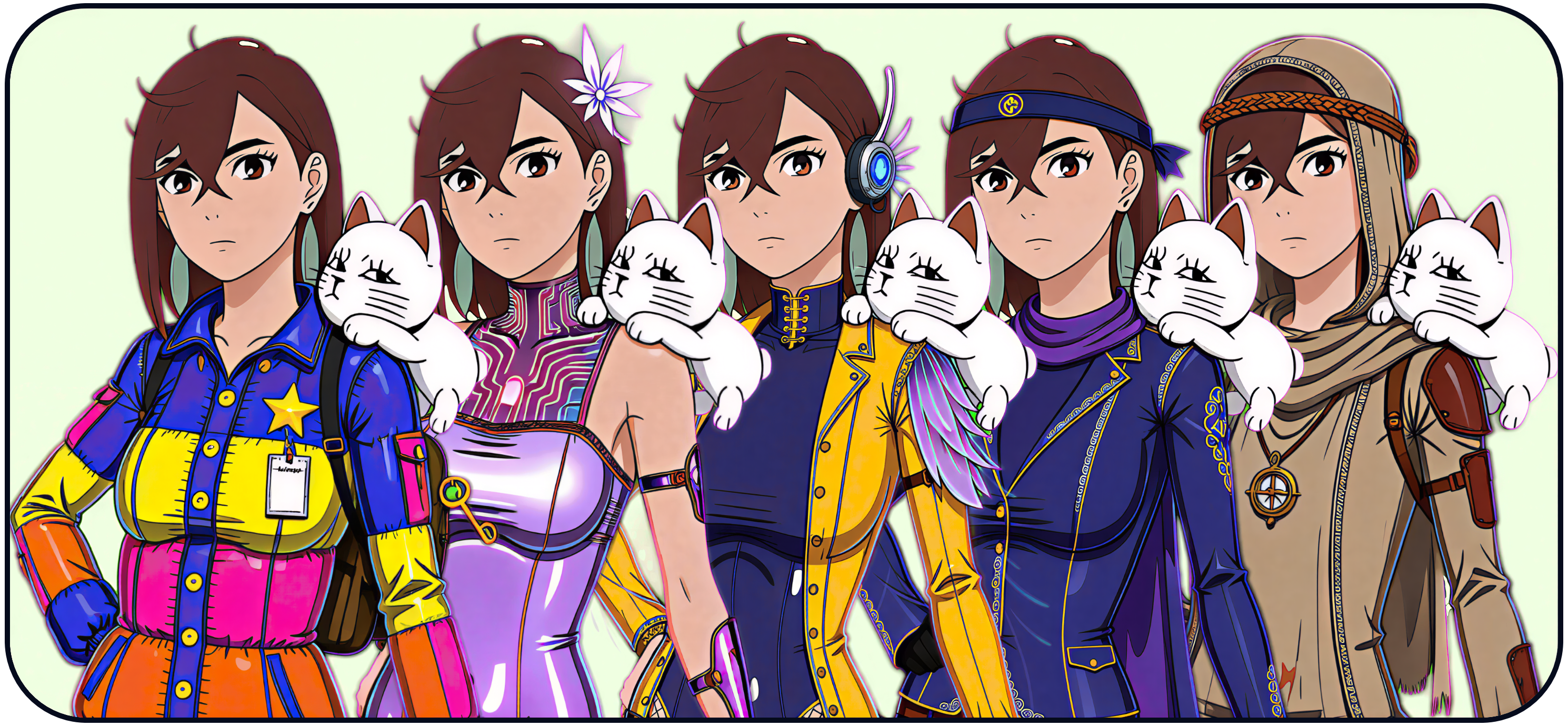
VNCCS - Visual Novel Character Creation Suite
VNCCS is a comprehensive tool for creating character sprites for visual novels.
Nodes (45)
Pull a saved character and costume into prompt form
The natural-language version of the asset lookup
Turn a reference image into a VNCCS character
The raw tag-field version, for when you want every knob exposed
Start a consistent character without fighting tags
Split a sprite sheet back into individual sprites
Build an outfit for a character you already made
Turn a character's sprites into a captioned training set
Batch out facial expressions for an existing character
Pick expressions from a grid instead of typing a list
Pulling a finished character's sprite set out of ComfyUI
Pull already-generated sprites back into your graph
Clothed and undressed sprite sets from one clone
Pose, upscale and cut out a character in one node
The node that actually makes your sprites transparent
The sandbox version, minus SAM3 recovery
Turns one outfit sketch into a full sprite set
Pick an aesthetic instead of typing an outfit from scratch
Two sliders to undo the contrast and saturation drift diffusion leaves behind
The node that downloads everything else needs
The Step-3 node that turns one calm face into a whole expression set
A labeled number box for feeding the rest of the pack
Flux Klein conditioning, one node instead of five
Batch a handful of images into one output
A whole-number primitive for VNCCS graphs
A LoRA loader you can switch off without rewiring the graph
Stack multiple LoRAs into one model/clip pair
Turning an alpha channel into something you can actually look at
Step 0, moving your old characters into VNCCS 3.0 format
A plain text box for feeding prompts into the VNCCS graph
The bus node that carries model, clip, vae and your sampler settings in one noodle
Drawing the skeleton VNCCS poses your character with
Four text slots and a separator, nothing more
Cutting a 2x2 grid apart, or gluing four images into one
The node doing the actual Qwen-Image-Edit work under VNCCS 3.0
A plain image resize node, VNCCS house style
Four background-removal models behind one dropdown
A simple dropdown with one nasty compatibility trap
Batch-rendering every emotion in the config, for QA not for players
Pulling one panel out of a 2x6 sprite sheet
Split a sprite sheet into twelve panels, or build one back up
A single-line text box for feeding names and tags into the graph
Render all 40 sprite styles before you commit
A plain any-type box for wiring VNCCS graphs together
Turning a reference photo into clothing VNCCS can clone
<table> <tr> <td width="50%" align="center"> <strong>Join The Community</strong><br> Share results, ask questions, and follow VNCCS updates.<br><br> <a href="https://discord.com/invite/9Dacp4wvQw" target="_blank"><img src="images/VNCCS_Discord_Button.png" alt="Join our Discord"></a> </td> <td width="50%" align="center"> <strong>Support VNCCS</strong><br> VNCCS is developed independently. Support helps keep the project moving.<br><br> <a href="https://www.buymeacoffee.com/MIUProject" target="_blank"><img src="images/VNCCS_Donate_Button.png" alt="Support VNCCS"></a> </td> </tr> </table>
VNCCS is NOT just another workflow for creating consistent characters, it is a complete pipeline for creating sprites for any purpose. It allows you to create unique characters with a consistent appearance across all images, organise them, manage emotions, clothing, poses, and conduct a full cycle of work with characters.
Description
Many people want to use neural networks to create graphics, but making a unique character that looks the same in every image is much harder than generating a single picture. With VNCCS, it's as simple as pressing a button (just 4 times).
Installation
For new ComfyUI users: Use VNCCS Easy Install. It installs ComfyUI with a preconfigured setup and working VNCCS nodes.
For experienced users:
Find VNCCS - Visual Novel Character Creation Suite in Custom Nodes Manager and click install latest version
Manual install:
- Rename the downloaded node folder to
vnccsand place it intoComfyUI/custom_nodes/. The resulting path must beComfyUI/custom_nodes/vnccs/. - Alternatively, in the console: go to
ComfyUI/custom_nodes/and rungit clone https://github.com/AHEKOT/ComfyUI_VNCCS.git vnccs cd vnccspip install -r requirements.txtpython install.py
Run both commands with the Python interpreter that starts ComfyUI. ComfyUI-Manager
runs install.py as its installation hook.
Post install steps: Launch ComfyUI and open Comfy Manager Click "Install missing custom nodes"
VNCCS 3.2 Workflow
Hi! My name is V-chan, and I am going to show you how to use the new VNCCS!
We got a BIIIIIIG update, and now everything is completely new, so listen carefully!
Step 1: Character Creator
Open the workflow:
VNCCS_3.2_Step1_CharacterCreator.json
Let's start from the very beginning. The first thing you need to do, besides opening the workflow, silly, is figure out the VNCCS Control Center.
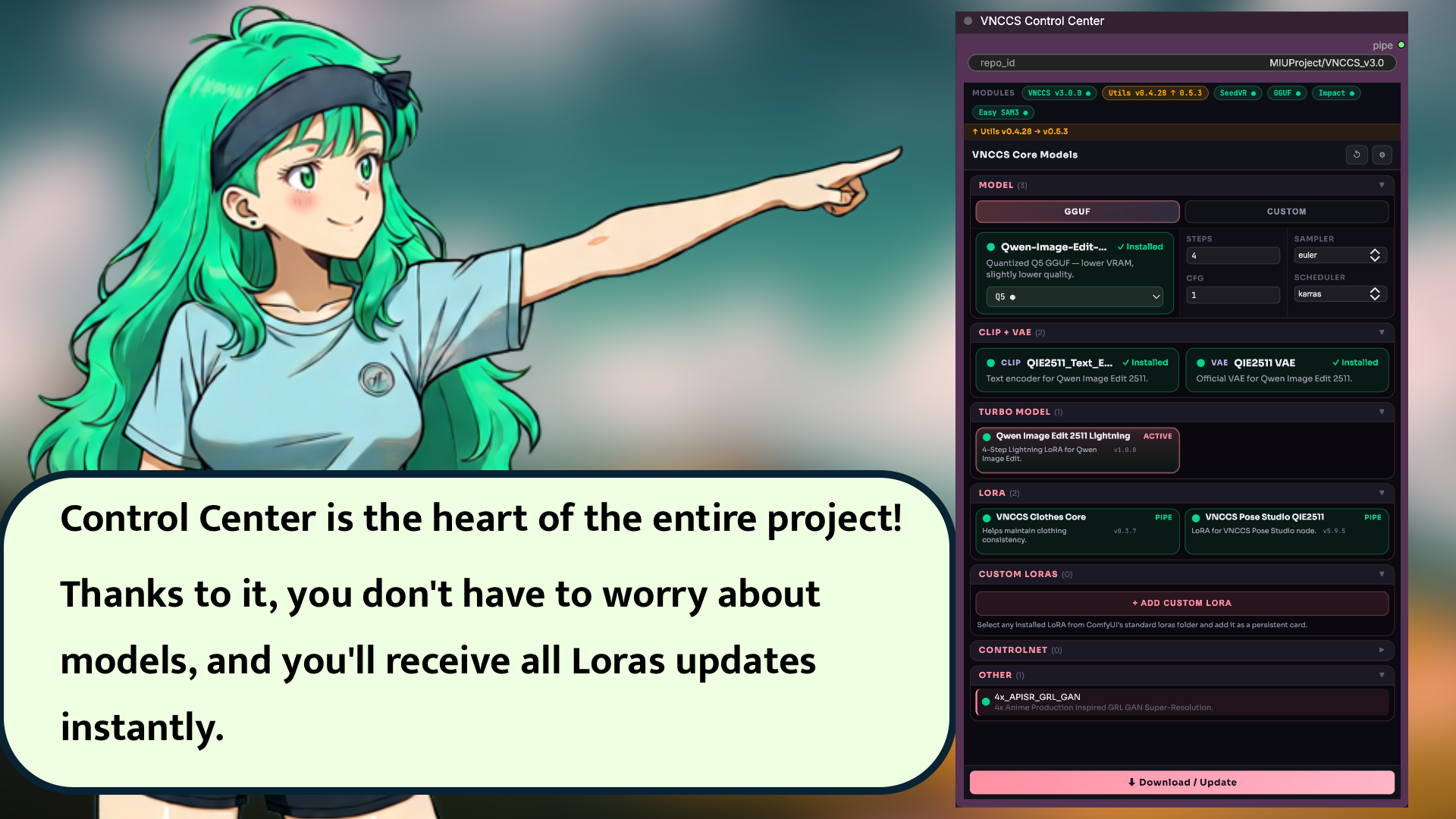
Inside it, you will find the models that turn your character into different poses and outfits. Choose the one that fits your computer and press Download.
- Qwen Image 2.1 works from your character image to change poses and clothes. It can even give you a transparent background. Less green-screen trouble, yay!
- Flux Klein9b makes your sprites in just 4 steps. Want less waiting while trying poses and outfits? Give it a try!
- MiniMax H3 is a video model, but here it helps you make character sprites! Try it for poses and clothes too, and see which result you like more.
Choose wisely, but in the end nobody is stopping you from trying them all and deciding later.
And then, at the very bottom of the widget, you can click the big Download button and the magic will do everything by itself.
<table> <tr> <td width="50%" align="center" valign="top"> <img src="images/v3.3/controlcenter.webp" width="100%" alt="Downloading model components in VNCCS Control Center"> </td> <td width="50%" valign="top"> <strong>Let the Control Center do the downloading!</strong><br> Choose the model components you need and press <strong>Download / Update</strong>. The model cards show download progress and installation status, so you can see when everything is ready for your character adventures. </td> </tr> </table>Next, go to VNCCS Character Creator V2.
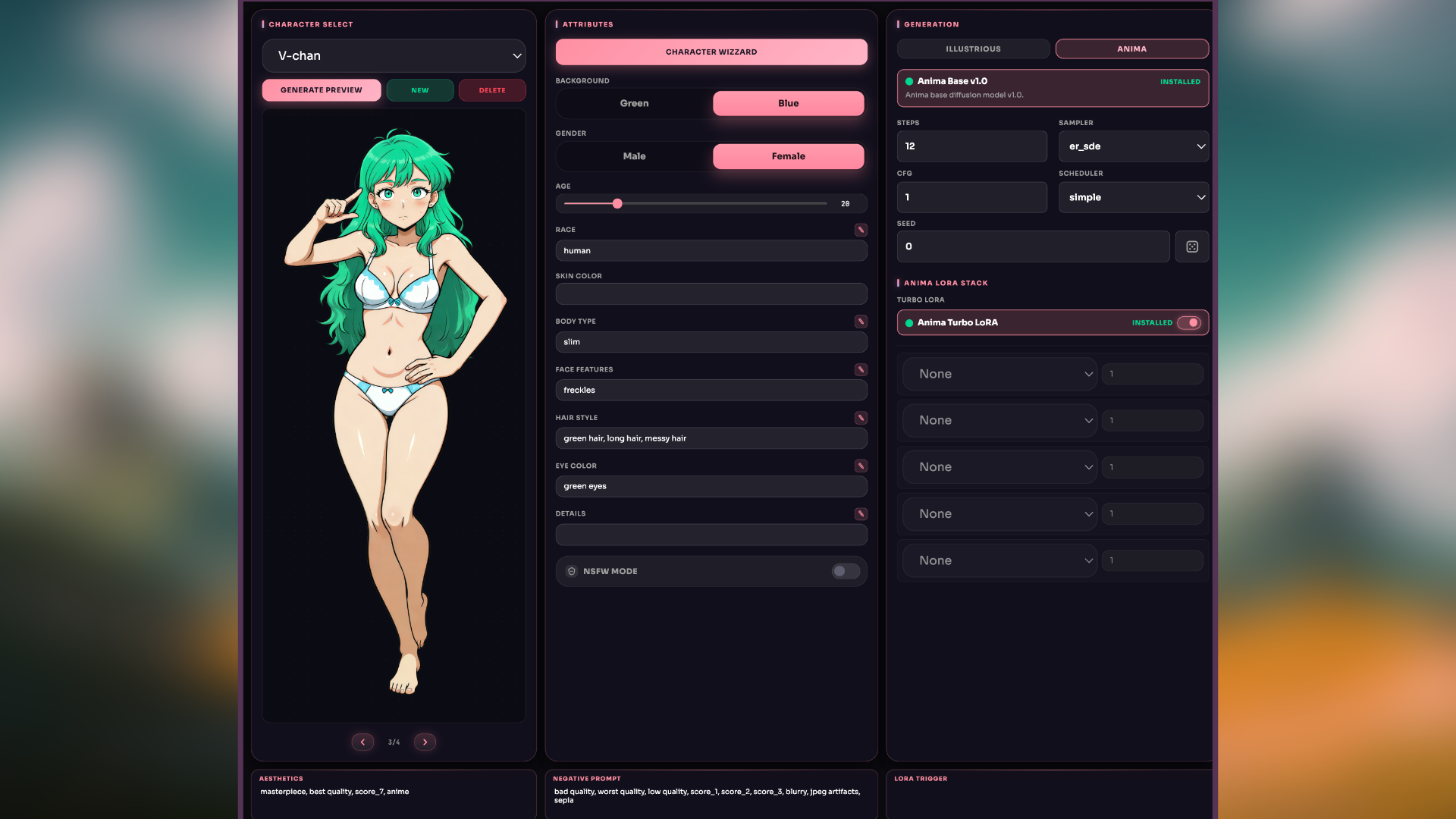 The most important thing here is to create a new character and choose the model for generation.
Illustrious may be considered old, but it makes excellent characters and has a huge selection of LoRAs for every style and occasion. Do not worry about quality, it will not disappoint you!
Anima is a new and cool model. It can do almost everything, but it will need a bit more resources, and there are not as many LoRAs for it yet.
Qwen Image 2.1 is here too! It can create your character with a transparent background, and the Turbo option cuts down the number of generation steps. More time to try different characters, hehe!
I recommend trying all three and deciding for yourself.
Right now you do not have any characters yet, so press NEW and give him or her a name! The name is very important!!! Be creative and unique!
Done? Good job! Now you have two paths:
- Enter character descriptions or use the pencil buttons to choose curated presets for race, skin tone, body type, face, hair, eyes, and details. Choose sex, age, and generation type. The NSFW switch controls whether the base character will have clothes or not :3
- Press CHARACTER WIZZARD, describe the character you want, and after a little magic the system will set all the needed options by itself. Do not forget to check them!
Race presets include natural-language descriptions of their distinctive anatomy, added automatically to generation prompts in Illustrious, Anima, and Qwen Image 2.1. Select multiple species for hybrids, or enter custom traits; the prompt gives explicit character traits priority over preset defaults. Existing character fields and custom text remain supported. Breast-size presets retain their original tags. Creator V2 uses character_template/character_presets_v2.json; the legacy catalog remains available to Character Cloner.
Click the Style card to open the style library. Built-in styles and their 1024×1024 WebP previews ship with the node in character_template/character_styles.json and character_template/style_previews/. Style prompts describe artistic rendering; background, pose and framing remain separate Creator settings.
Choose Custom style or New style to enter a name, short description, reference and style prompt. Save style adds it to My styles; Generate preview saves it and renders only that style using the current character tags and generation settings, a square portrait and seed 0. Resolution scale controls the render quality before the preview is resized to 1024×1024. Previews are composited onto the same dark gradient as the style cards and saved as opaque WebP at quality 90 directly inside the node, rather than ComfyUI's output directory. User styles live in character_template/character_styles.user.json, with user_*.webp previews alongside the built-in images; these user files are excluded from Git and packaged updates.
The × button in the upper-right corner of a user style card opens a deletion confirmation. Confirming removes its library entry and preview, if present. Built-in styles cannot be deleted. Deleting the selected style switches the Creator to its default style.
Style edits carry the revision returned by /vnccs/character_styles. A stale edit returns HTTP 409 and keeps the editor draft open. Keep any draft text before reloading the current style.
If a user style changes during preview generation, the render returns HTTP 409 and preserves the previous preview. Generate the preview again for the updated style.
A new little feature is the GENERATE PREVIEW button. It lets you see what the character will look like without restarting the whole generation. So press it already, and if you like everything, move on. If you want to make changes, edit the descriptions and press it again!
<table> <tr> <td width="50%" align="center" valign="top"> <img src="images/v3.3/character_preview.webp" width="100%" alt="Generating a character preview inside VNCCS Character Creator V2"> </td> <td width="50%" valign="top"> <strong>Meet your character before the big generation!</strong><br> Press <strong>GENERATE PREVIEW</strong> and watch the character appear in the Creator's preview panel. Check the face, hair, body, and overall look. Something does not feel right? Change the character descriptions and try again until you are happy with the result! </td> </tr> </table>Creator and Cloner run with the character settings restored from the workflow and save them to the selected character's profile. Restoring a workflow keeps its draft fields; it does not require a profile version. Storage locks and atomic writes protect the save, while unreadable configurations and metadata belonging to another character are rejected.
VNCCS Pose Studio
The next key node is VNCCS Pose Studio.
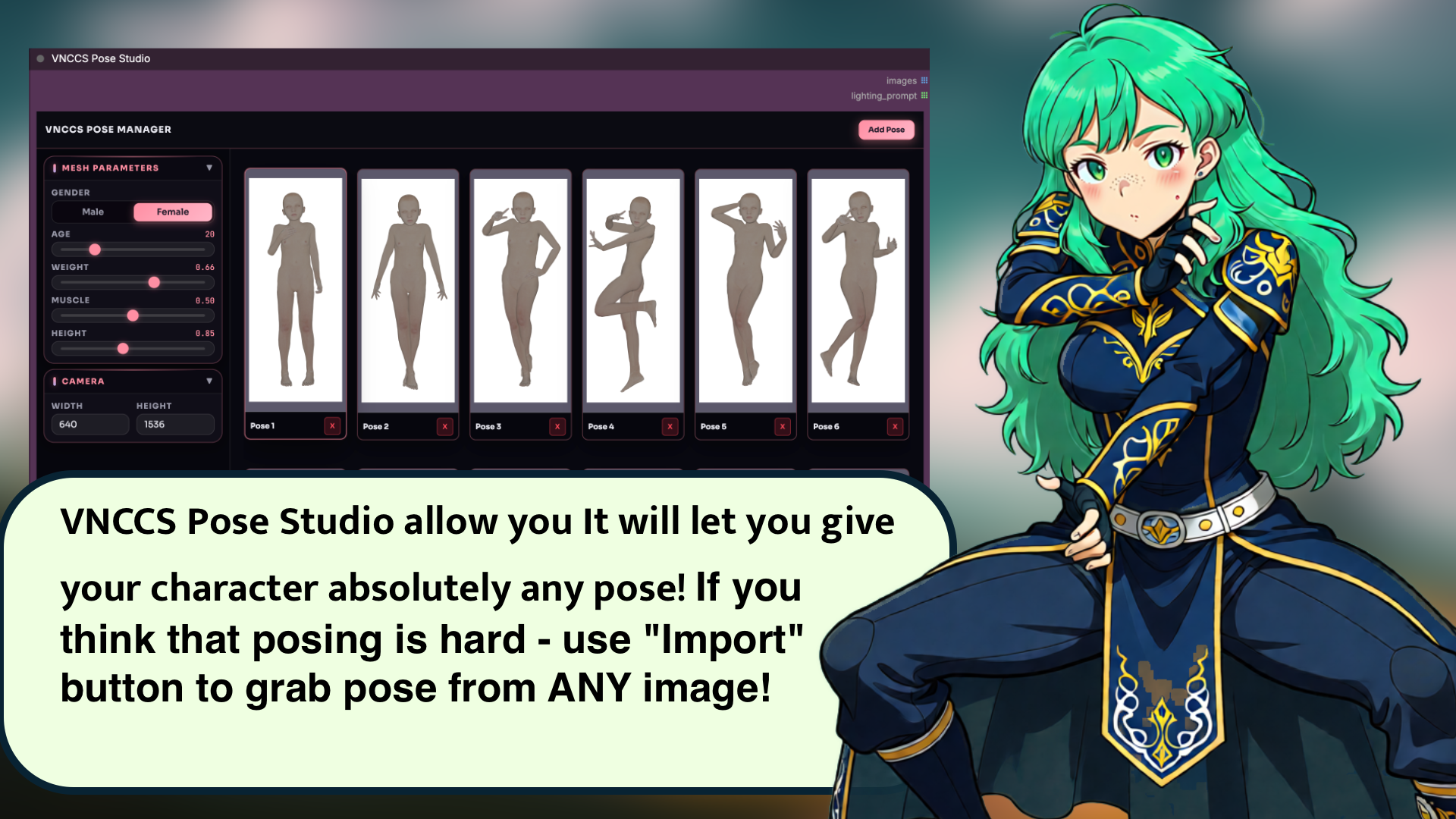
It is downloaded from my second project, VNCCS-Utils, so do not forget to install that too!
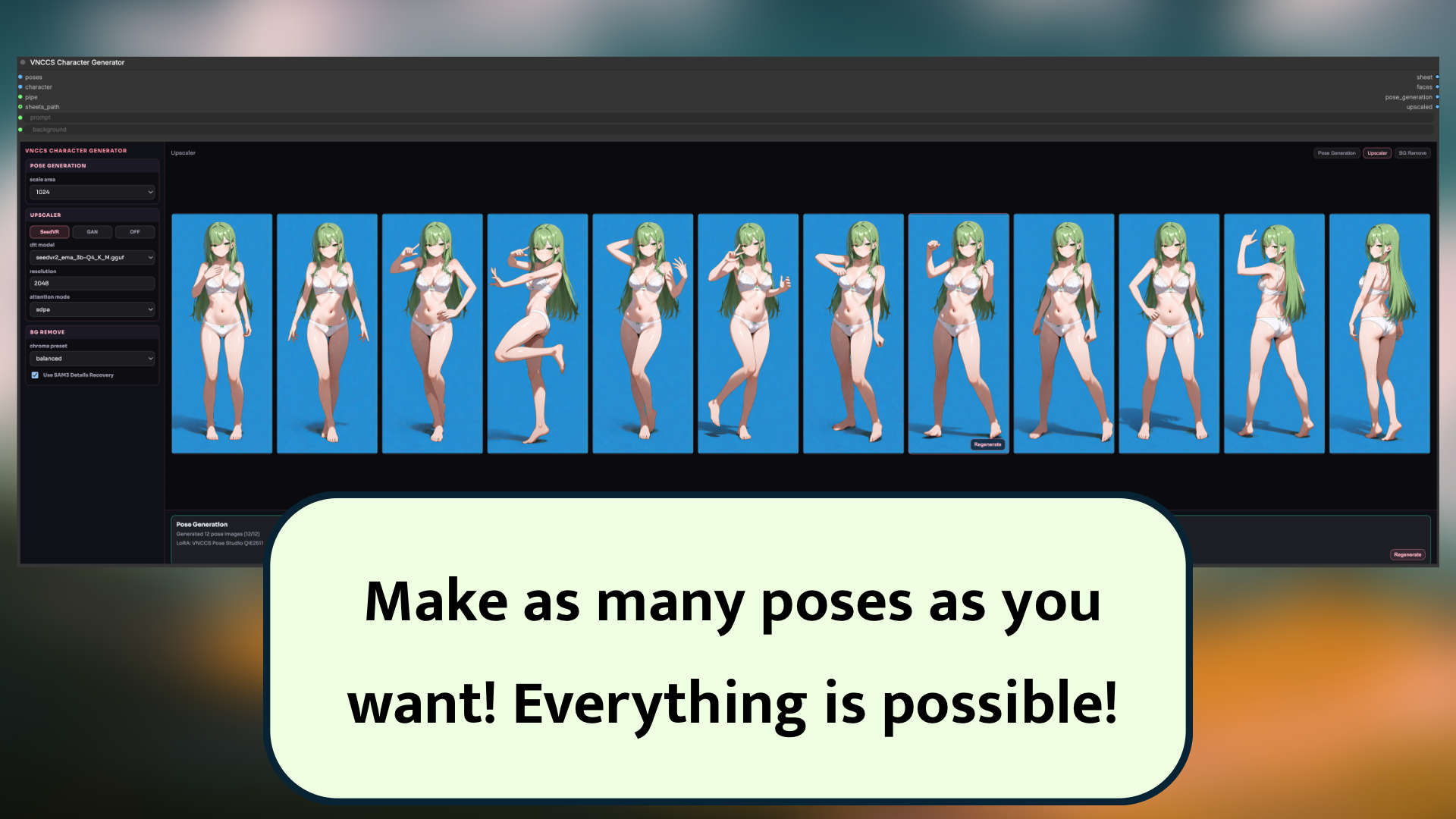
Here, the most important thing is to choose the poses you need and how many of them there should be. You can control the model however you want and make absolutely any poses. Also, using the Import button, you can load any picture with a character and get a pose just like the one in the picture!
It is also very important that the body proportions of the model fit your character. Age will be set automatically from the previous step, but nobody will stop you from setting it manually. Also choose height and body type, the result will be much better that way.
In VNCCS Character Generator, you do not really need to worry about the settings, but if you want, you can choose the upscaler model or even turn it off.
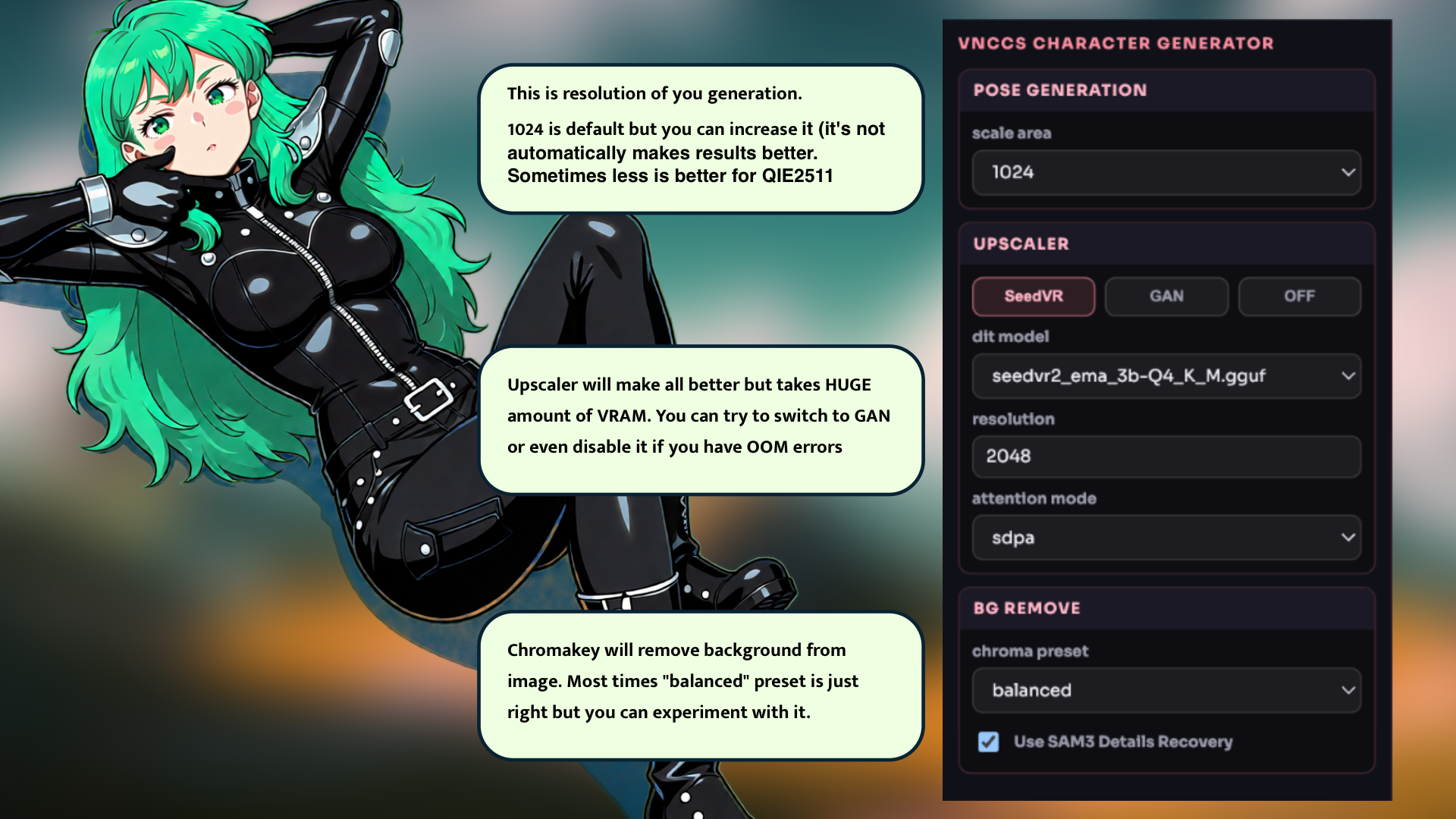
In BG Remove, you can choose a chroma key preset. Balanced is a very good preset, but if it is not enough for you, or if it is too much and starts damaging the character, choose a lighter one.
SAM3 Details Recovery makes background removal slower, but it lets you worry less about eye color and clothing elements that are the same color as the background. We will talk about clothes a little later.
Ready? Then press Run! Now just wait, and the magic will do everything for you!
Step 1.1: Character Cloner
Open the workflow:
VNCCS_3.2_Step1_CharacterCloner.json
This workflow is basically a complete copy of Character Creator, but it is made for cloning existing character images.
Did you generate the character with another model? Download it from the internet? Take a screenshot from your favorite anime? Draw it yourself, with your own hands? Good job!
Try to make sure the picture is good quality and that the character is full body, otherwise the model will invent everything that is not visible in the picture!
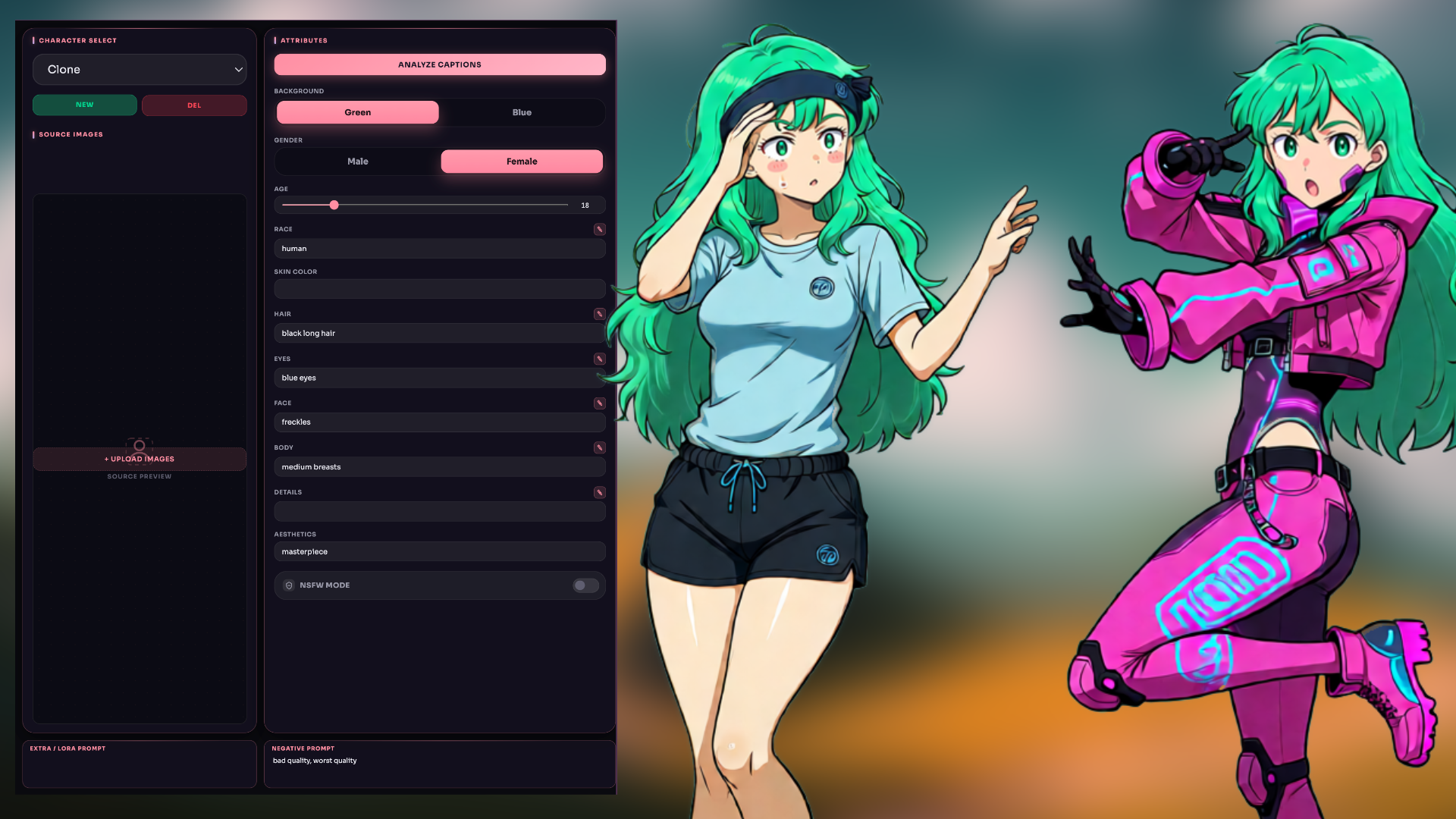
Now load it into VNCCS Character Cloner, write tags or press ANALYZE CAPTIONS, set up everything you need in VNCCS Pose Studio, and do not forget to choose whether you need separate undressed sprites with the NSFW button. They are not mandatory, but dressing these characters later will be MUCH easier!
Also try to choose a background color that appears the least in the character. Look at the eyes and hair. If they are green, choose blue. Or the other way around.
Now press Run and look at the result!
Step 2: Character Clothes
Open the workflow:
VNCCS_3.2_Step2_CharacterClothes.json
Now we move to the tastiest part! In this workflow, you will make clothes for the character. As many sets as you think you need.
Choose a character in VNCCS Clothes Designer and press New. Give the outfit set a name and get ready to create!
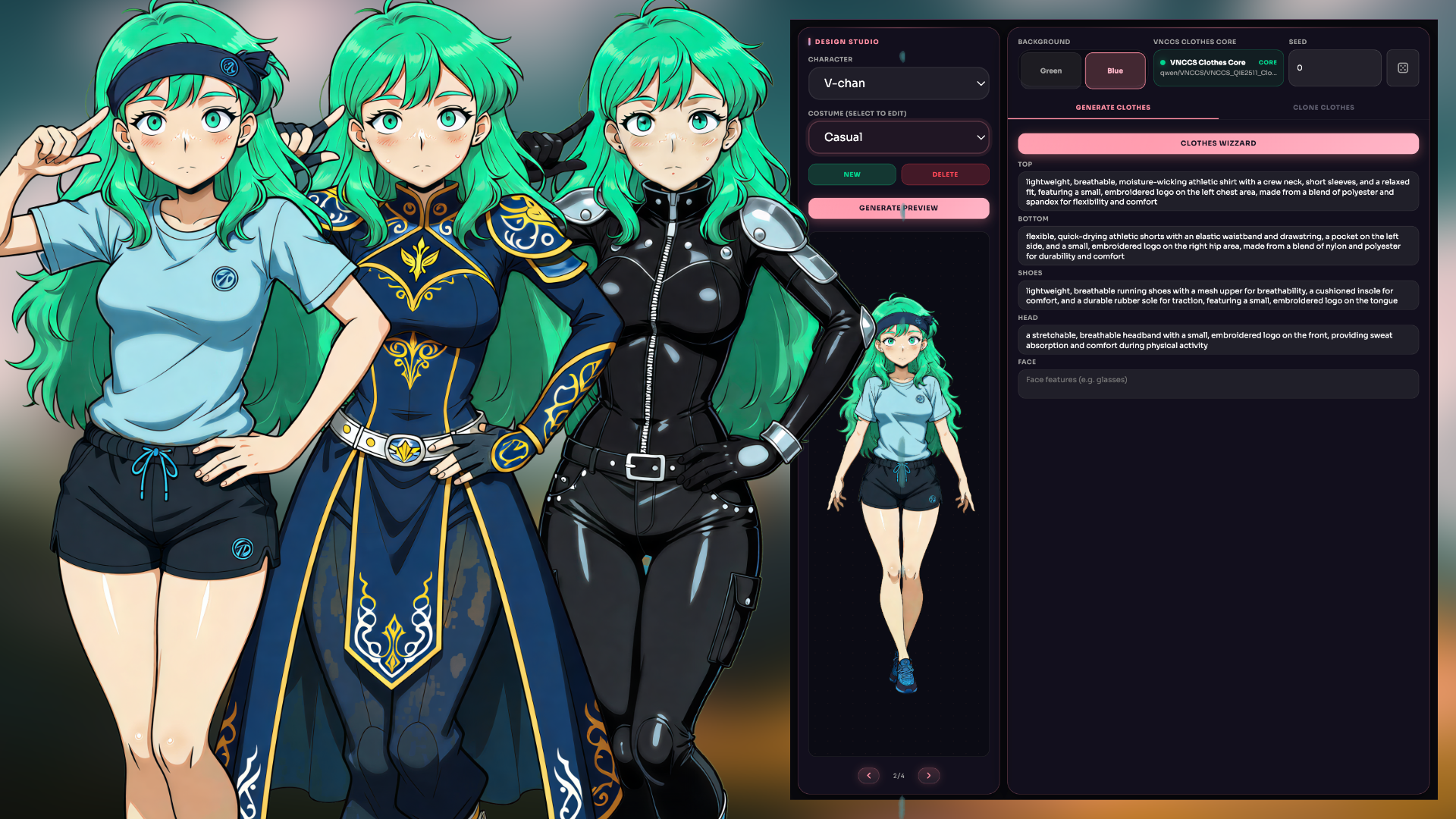
You have two options again:
- Describe all clothing elements in the needed fields. You do not have to follow them exactly, but the head and face sections will help you later not to lose details during emotion generation, so do not slack off! If the character has glasses, write them in face. A hat goes in head. Easy!
- Press Clothes Wizzard and simply describe the clothes you want!
You also have an option to clone any clothes from any picture! Open the CLONE CLOTHES tab and upload an image of clothes, or a character wearing clothes.
The GENERATE PREVIEW button will help you see what your character will look like before starting the big and heavy generation of all poses.
<table> <tr> <td width="50%" align="center" valign="top"> <img src="images/v3.3/new_clothes.webp" width="100%" alt="Creating a costume, filling its fields with Clothes Wizzard, and generating an explorer outfit preview"> </td> <td width="50%" valign="top"> <strong>A new outfit, from idea to preview!</strong><br> Choose your character, press <strong>New</strong>, and give the costume a name. Open <strong>Clothes Wizzard</strong>, describe the outfit, and press <strong>FILL FIELDS</strong>. Here, a short explorer-clothes idea becomes descriptions for the top, bottom, shoes, head, and face. Check those fields, then press <strong>GENERATE PREVIEW</strong> to see the character dressed for an adventure. A hat, boots, goggles... ready to go! </td> </tr> </table>And that is all! Again, do not forget about VNCCS Pose Studio, and press Run!
When you finish the first set, you can press New again and create as many outfits as you want!
Costume saves detect changes made in another editor. A conflicting save preserves your local draft instead of replacing newer metadata or recreating a deleted costume. Reload the costume before retrying; retain any draft text you want to apply to the current version.
API clients must read /vnccs/get_costume and send its ETag header as the revision field when posting an edit to /vnccs/save_costume. Successful saves return the next revision; stale edits return HTTP 409, and edits without a revision return HTTP 428. Creating a new costume uses create_only: true.
Deleting and recreating a costume changes its version even when its name and fields are identical. Clothes Generator rejects the protected Naked and Original sets and requires an editable costume.
Step 3: Character Emotions
Open the workflow:
VNCCS_3.2_Step3_CharacterEmotions.json
Here we will create emotions for the character! Up to this moment, all sprites had a calm facial expression. This will be our base.
In the VNCCS Emotion Studio widget, choose the character you are going to make emotions for. In Selected costumes, choose all costumes you want to work with.
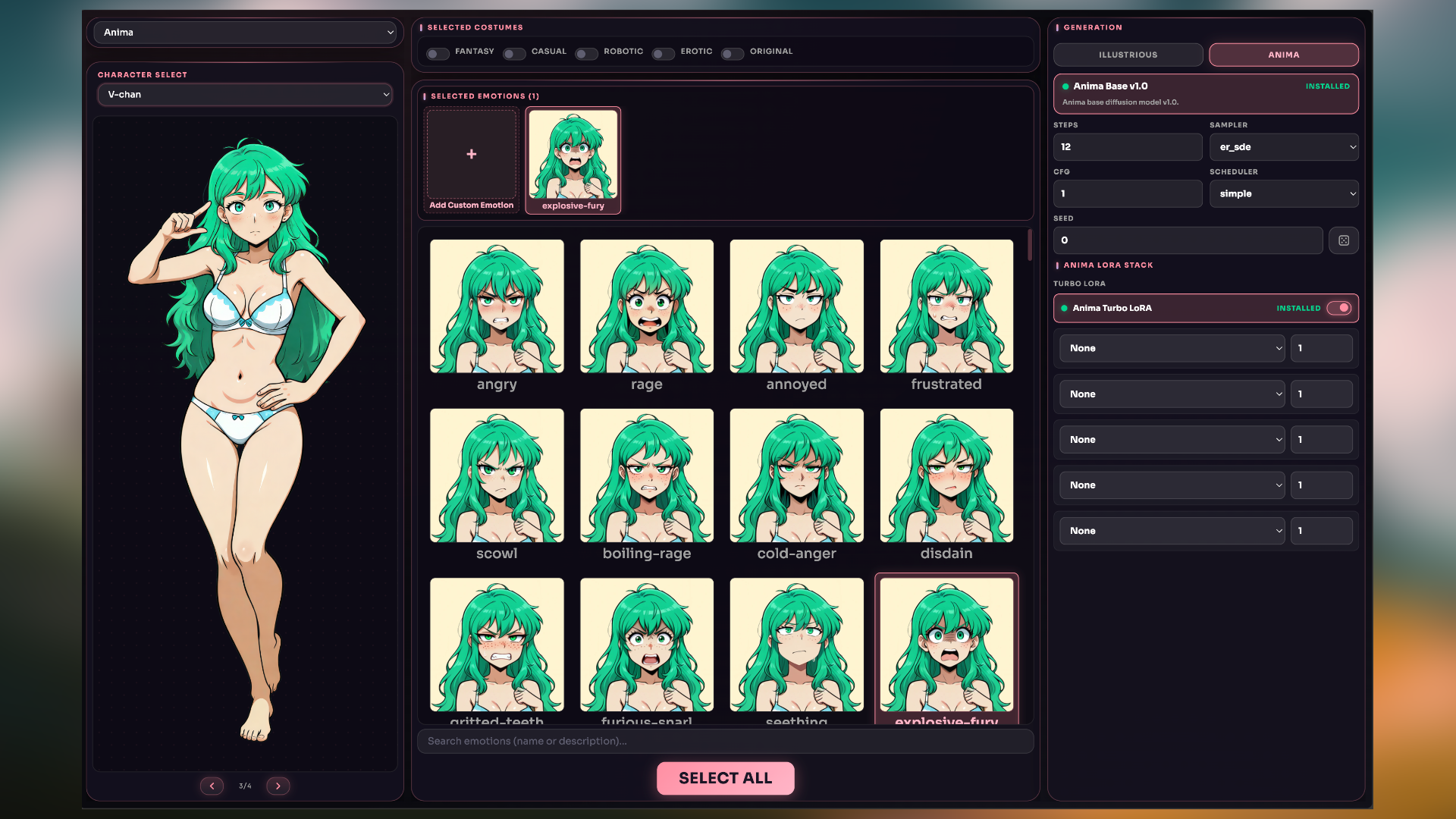
Now, in the huge list, click the emotions you need and add them to the selected ones. Also, if by some miracle you did not find what you need, you can add a Custom emotion and describe what you want yourself.
<table> <tr> <td width="50%" align="center" valign="top"> <img src="images/v3.3/emotions.webp" width="100%" alt="Selecting emotion cards and using search to find another expression in VNCCS Emotion Studio"> </td> <td width="50%" valign="top"> <strong>Pick the expressions your story needs!</strong><br> Click emotion cards to add them to the selected list above the library. Use the search field to find a particular expression without scrolling through every card. The animation builds a small selection of different moods. A little pout, a happy smile, maybe something more mischievous? </td> </tr> </table>After that, you again need to decide which model will do the generation.
Illustrious is stable, but the variety of emotions depends very strongly on the exact character, style, and model. Not all emotions may come out equally well.
Anima makes very cool emotions, but it is still too young, so it can be unstable. It can change character details too much, so try it yourself and decide what you like better.
Qwen Image 2.1 can make emotions too! It works on the face and puts it back into your sprite, keeping the rest of the image in place. Describe the expression you want and give it a try!
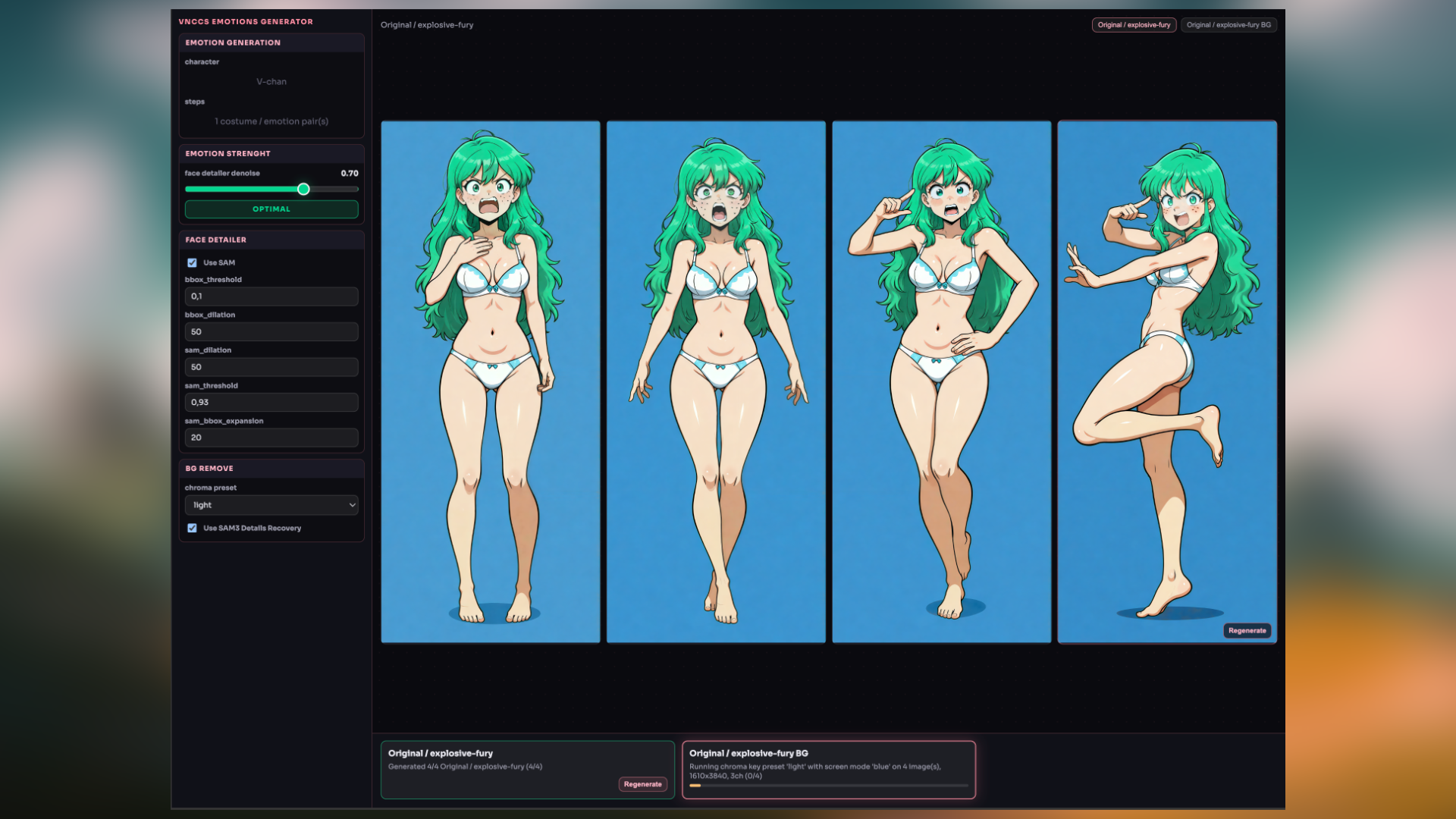
If you chose Illustrious or Anima, the most important setting in VNCCS Emotions Generator is Face Detailer Denoise. It will suggest optimal values by itself, but remember one basic idea: the higher the denoise, the more the original image changes.
More denoise means a brighter emotion, but the character may stop looking like themselves.
Less denoise means a more accurate character, but the emotion may be weaker.
There is no ready-made recipe here. It all depends on the character and the selected model, so be creative and a tiny bit more patient.
For the first try, do not select all costumes and emotions at once. It will take a long time, and if the result does not satisfy you, it will be sad. Better find the optimal settings first, and then go all in!
Press Run, and may luck be with you!
<table> <tr> <td width="50%" align="center" valign="top"> <img src="images/v3.3/emotions_gen.webp" width="100%" alt="Generating the yandere-smile expression across multiple character poses"> </td> <td width="50%" valign="top"> <strong>Now let your character show some feelings!</strong><br> Here, <strong>Qwen Image 2.1</strong> applies the selected <strong>yandere-smile</strong> expression to the character's poses. The pose cards update as each sprite is generated, while the progress bar shows the batch status. Check the faces before moving on to a bigger batch! </td> </tr> </table>At this point, the current VNCCS features end, but not for long! Planned features include animations, 3D environments and CG image creation inside them, character voice generation, and music track generation for your game or project.
You will find all your sprites inside ComfyUI in:ComfyUI\output\VNCCS\Characters\ folder
Be careful with them, and do not delete them by accident while cleaning your disk!